These
pages provide news, articles, and links about
historical ciphers and codes, cipher machines,
and cryptography-related exhibits and events,
from ancient history through the First and Second
World Wars to the Cold War and beyond.
If you
have interesting news on cryptologic
history, then contact
us. History
is here to share!
NEW WEBSITE ON CRYPTO MYSTERIES
BY KLAUS SCHMEH 13 July 2026
Klaus Schmeh's Website
Klaus Schmeh is a
well-established expert in the international
historical cryptography community. In 2013, he
launched the Cipherbrain blog, covering all types
of codes and ciphers, both solved and unsolved.
The topics range from the Voynich Manuscript and
Kryptos sculpture to the German Enigma and other
cipher machines, as well as encrypted texts
spanning the past 3,000 years.
He also published numerous
books on cryptology in both English and German,
and has authored many articles for the renowned
Cryptologia journal. He now launched a brand-new
English-language website dedicated to
crime-related ciphers, unsolved cryptologic
mysteries, and encrypted books. The new site also
features cipher machines, a cryptologic travel
guide, a photo gallery, and much more.
Visit klausschmeh.net to explore
a wealth of cryptologic history and fascinating
stories. The website is also home to the new
English-language Cipherbrain blog. Older posts in
German remain available on the original Cipherbrain blog.
BLETCHLEY PARK PODCAST ON
CODEBREAKING DURING WORLD WAR II 19 June 2026
During the Second World War,
signals intelligence (SIGINT) was vital to gather
information on the enemy. The British Government
Code and Cipher School (GC&CS) at Bletchley
Park was responsible for cryptanalysis, the
breaking of diplomatic communications and enemy
military codes and ciphers, at both tactical and
strategic level. The intelligence, derived from
high-level encrypted communications, was
codenamed ULTRA. The main focus was on the German
Enigma and Lorenz cipher machines, as well as
various other German and Italian radio
communications. This information played an
important and often decisive role during World
War II.
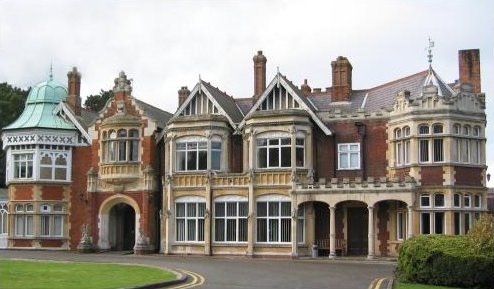
Bletchley Park - Home of the
British codebreakers during WW2
Initially,
intercepted messages were broken by hand. From
1940 onwards, they also started using an analytic
machine called the Bombe, developed by Alan
Turing and Gordon Welchman to accelerate the
decryption of messages, encrypted with the German
Enigma machine. Additional machines were
developed to assist cryptanalysis of various
other cipher systems.
One of these was Colossus, the
world's first operational programmable digital
electronic computer, developed by mathematician
Max Newman and built by Tommy Flowers from the
Post Office Research Station. The Colossus
assisted in breaking the Lorenz SZ40/42
teleprinter traffic. More about the Colossus on
our website in English or Nederlands.
In 1945, about 9,000 people
worked at Bletchley Park and various outposts.
Although primarily known for its brilliant
codebreakers, including Alan Turing, John
Tiltman, Gordon Welchman, and Dilwyn Knox, many
outstanding female codebreakers also worked at
Bletchley Park. Among them were Joan Clarke,
Mavis Batey, Margaret Rock, Ann Katharine
Mitchell, and many others.
The Bletchley Park Podcast
shares fascinating stories about the
codebreakers, both male and female, the vast
workforce that supported them, and the machines
they developed. The podcast also explores the
breaking of Axis military and diplomatic
communications, and how its intelligence
influenced the outcome of famous battles on land,
at sea, and in the air.
ENIGMA SIMULATOR BY BRIAN NEAL
ON WW2CRYPTO.ONLINE 08 March 2026
Brian Neal
successfully completed our Enigma Challenge in
2012. Since then, he was hooked on crypto
machines and started that same year his own
Py-Enigma project which found its way to GitHub.
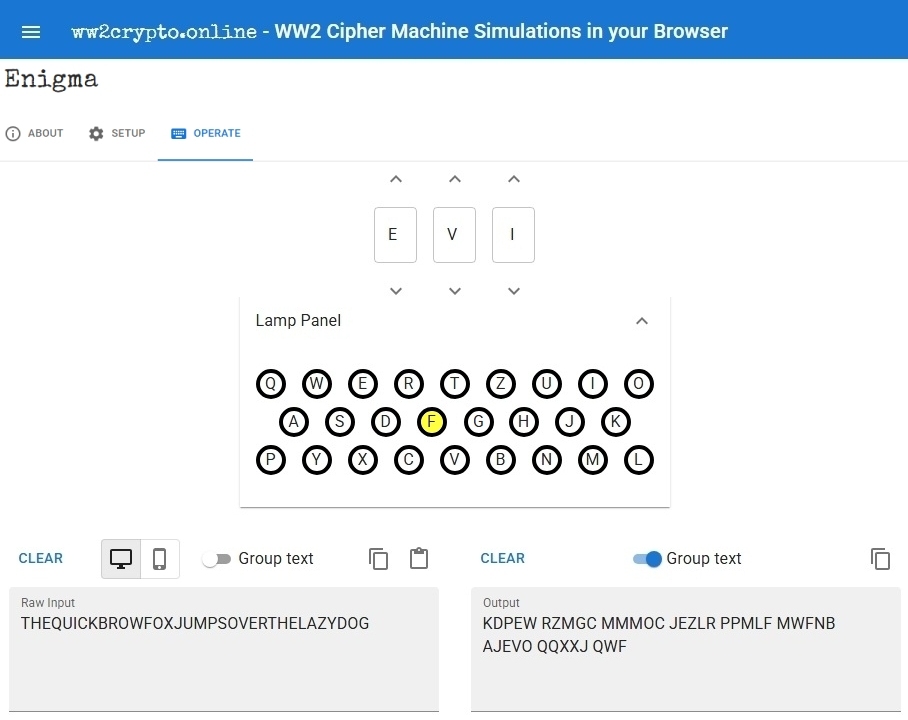
Last December, Brian created the website ww2crypto.online to make his
browser-based Enigma simulation available to
everyone. He also developed simulations of the
U.S. M-209 and the Japanese PURPLE machine, and
plans to develop more crypto machines to run in
your browser.
Keep an eye on ww2crypto.online as more simulations will be
added.
HISTORY OF THE KL-7 ADONIS
& POLLUX - THE FINAL UPDATE? 15 November 2025
TSEC/KL-7
We just
published version 5.3 of the history of the
TSEC/KL-7 cipher machine. Our first encounter
with the KL-7 was in 2005 aboard the battleship
HMS Belfast, where it was displayed behind glass.
It then took six more years of research to create
an accurate simulation of this Cold War
cryptologic marvel. None of this would have been
possible without the help of Paul and Marc from
the Crypto Museum, the late George Mace, and Bill
Neill’s FOIA contributions. Their assistance
was invaluable in unraveling the technology
behind the KL-7.
The William
Friedman Collection was a treasure trove that
detailed the design choices and development of
the KL-7. Historical records from the U.S. Army
Security Agency contained production details,
planning and procurement, and reports on its use
in Vietnam. The first version of the KL-7 history
was published in 2022 and included references to
all relevant ASA, AFSA, NSA, CIA, and NATO files.
In the following years, many more documents and
bits of information surfaced, including FBI
documents and counterintelligence records about
the KL-7's compromise by John Walker and Joseph
Helmich. The research began in 2005, and although
all technical documents were declassified in
2009, the research ultimately took nearly two
decades as additional records were released
gradually.
The newest
version offers the most detailed history of the
TSEC/KL-7 ever published, but research continues.
Its use of electronics, worldwide deployment in
both war and peace, and involvement in espionage
cases make the KL-7 a true Cold War icon,
deserving its place in cryptologic history.
This is
the definitive history of the KL-7 unless we
discover additional information. Former operators
and technicians can help us preserve cryptologic
history by sharing personal experiences with
the now-declassified KL-7. We already documented
stories from a U.S. crypto tech at the Air Base
Saigon, a U.K. tech at JHQ Rheindahlen, and a
British merchant radio operator during the
Falklands War. However, more stories about the
KL-7 are essential to preserve its history.